Smoke Control System Design
Engineering-oriented smoke control solutions for indoor parking lots and large-volume structures.
EN 12101-3
Standard Compliance
300°C / 2h
Fire Resistance
CFD
Simulation Supported
NOVVES provides smoke control system design services for indoor parking lots, industrial facilities, technical volumes, tunnel-like structures and large closed areas. This service; It is not limited to just fan selection. A holistic system design is created by evaluating the architectural structure of the project, fire scenario, air flow directions, escape routes, exhaust points, fresh air need, automation scenarios and field conditions together.
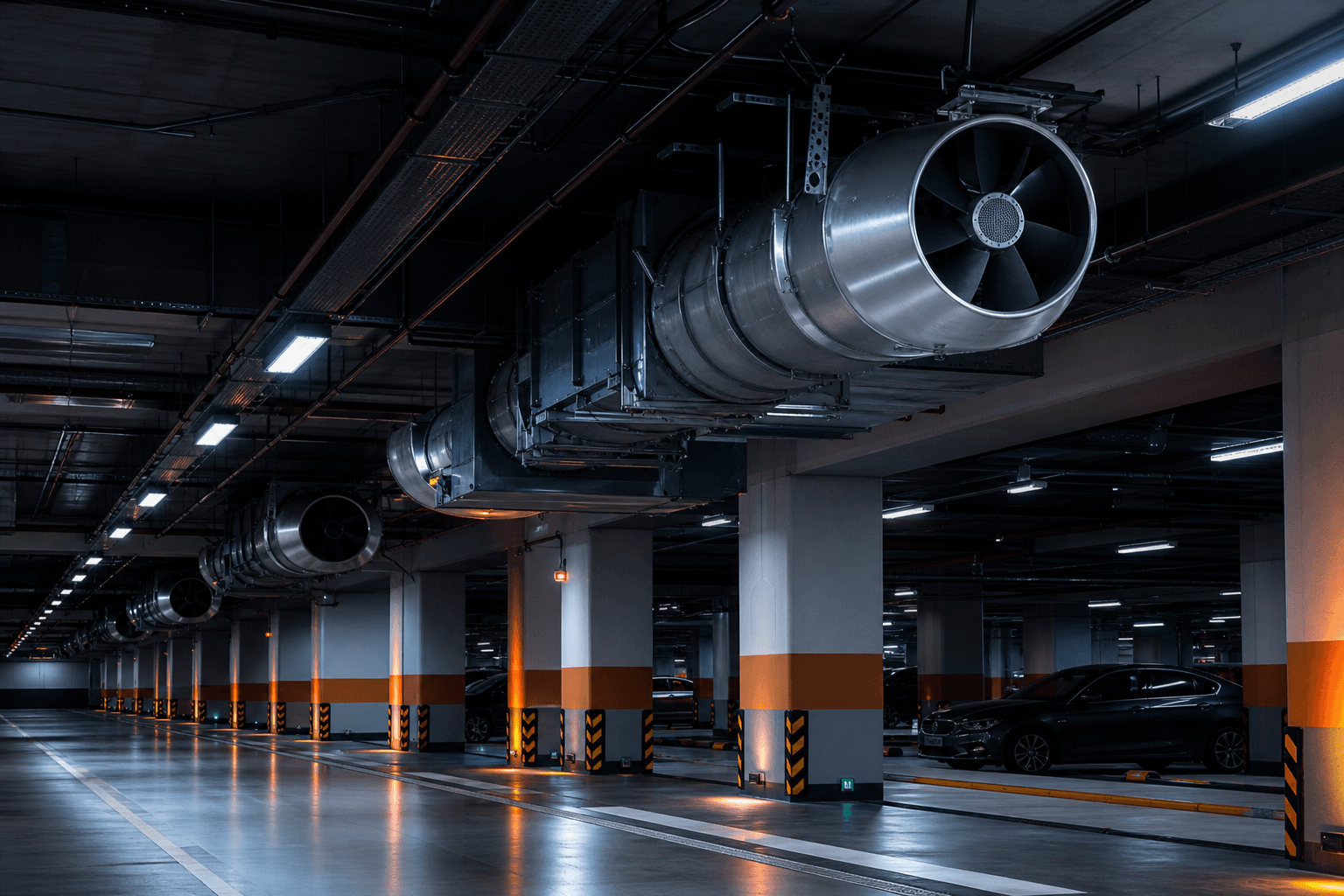
Jet fan systems; They are modern mechanical ventilation solutions used to direct air flow in indoor parking lots, evacuate exhaust gases from vehicles and ensure controlled removal of smoke in case of fire. NOVVES analyzes these systems on a project-specific basis, determines the correct fan placement and supports the smoke control scenario with engineering data.
The main goal in smoke control system design is; To protect indoor air quality under normal working conditions, to limit the uncontrolled spread of smoke in case of fire, to support the safety of escape routes and to create an air flow organization that will facilitate the intervention of fire brigades.
Design Approach
NOVVES Smoke Control Design Approach
Smoke control design for NOVVES is not just about equipment placement; It is an important part of the project's security strategy. The following elements are evaluated together in each project:
- check_circleParking garage or building geometry
- check_circleFloor height and volume information
- check_circleVehicle density and usage scenario
- check_circleFire scenario and possible smoke spread directions
- check_circleEscape routes, ramps, shafts and critical access points
- check_circleJet fan, exhaust fan and fresh air fan placement
- check_circleLocation of CO, smoke and heat sensors
- check_circleMCC / DDC control cabinet and automation scenarios
- check_circleBMS integration
- check_circleNeed for CFD analysis
- check_circleRegulation, standard and project specification requirements
- check_circleInstallation, maintenance and commissioning conditions
Thanks to this approach, the system is evaluated not only according to theoretical calculations, but also according to real field conditions and air movement behavior at the time of fire.
System Architecture
Components of Jet Fan System
- 01
Jet Fans
Jet fans are the main air direction elements of the system. Mounted on the ceiling, it creates high-speed airflow and directs polluted air or smoke towards exhaust points. Axial jet fan or radial jet fan types can be used depending on the project need. Axial jet fans can be selected according to one-way or two-way operating principle.
- 02
Exhaust Fans
Exhaust fans discharge polluted air, CO concentration or smoke generated in case of fire, directed by jet fans, to the outdoor environment in a controlled manner. In smoke evacuation scenarios, the temperature resistance, flow capacity and operating time of the fans are evaluated according to the project conditions.
- 03
Fresh Air Fans
Fresh air fans are used when natural openings are not sufficient or fresh air intake cannot be provided in the desired direction. These fans support the air balance of the system and contribute to the organization of pressure and air movement to help prevent smoke from being directed to escape routes.
- 04
sensors
CO sensors, smoke sensors, heat detection elements and related field equipment produce data for the automation infrastructure of the system. Information from the sensors is transmitted to the control panel in line with the determined limit values and fire scenarios.
- 05
Automation and Control System
MCC / DDC control panels ensure that jet fans, exhaust fans, fresh air fans and sensors operate according to the scenario. System; It can be activated automatically according to different operating scenarios such as normal ventilation, CO evacuation and fire mode. It can be integrated with the building management system when necessary.
Why Jet Fan System?
System Advantages
Reduces Channel Requirement
Since jet fan systems work by directing air, they offer a more flexible solution than traditional duct type ventilation systems. In this way, the need for wide duct lines and numerous grilles or diffusers can be reduced.
Saves Space
Ceiling height and usable volume are critical in indoor car parks. Thanks to their compact structure, jet fans take up less space and contribute to more efficient use of architectural space.
Supports Energy Efficiency
When working with CO sensors and automation system, jet fans can be activated only when needed. Energy consumption can be optimized thanks to variable speed control and scenario-based operation.
Controls Smoke and Heat Evacuation
In case of fire, the jet fan system helps reduce the uncontrolled spread of smoke and direct the smoke to designated exhaust points. This approach supports the safety of escape routes and contributes to a more controlled fire response.
Provides Ease of Maintenance and Operation
As the channel density decreases, cleaning, maintenance and access processes can be managed more easily. Fewer mechanical components simplify the organization of maintenance in the operating process.
Easily Adapts to Architectural Structure
Jet fan systems can be designed flexibly according to different car park geometries, ramp locations, column placements and ceiling heights. In this way, applicable solutions can be developed in new projects and existing structures.
Optimizes Initial Investment and Operating Costs
Correctly designed jet fan systems; It can optimize the initial investment cost by reducing the need for channels, grilles and diffusers. Automation-supported working scenarios contribute to the management of long-term energy and operating costs.
Engineering
Important Factors in Design
In order for the smoke control system to operate efficiently and safely, all architectural, mechanical, electrical and operational conditions must be evaluated together from the first stage of design.
Placement of axial fans, smoke and heat discharge fans, fresh air fans and jet fans in the jet fan project; It should be designed taking into account the noise level, the need for air direction, the absence of dead zones where fresh air cannot reach, ease of installation, maintenance access, safety of escape routes and smoke diversion strategy in case of fire.
In closed car parks, vehicle exhaust gases, CO concentration, user traffic, vehicle circulation, ramps, columns, shafts, door openings and natural ventilation facilities directly affect air movement. Therefore, correct positioning of jet fans is critical for the system to direct the air flow in the most efficient way.
In a fire scenario, the aim is to prevent the uncontrolled spread of smoke and promote the safest possible evacuation conditions. For this reason, the operating scenario of the fans, sensor locations, automation panel, fire detection system and building management system integration should be planned together.
In necessary projects, CFD analysis is used to evaluate air flow, smoke dispersion, jet fan effect, dead zones, exhaust points and evacuation scenarios numerically. CFD-supported design helps verify fan placement and analyze system performance on a project-by-project basis.
Smoke Control Design with NOVVES
Our Service Scope
NOVVES offers production, engineering, CFD analysis, automation, commissioning and after-sales technical support capabilities in smoke control system design under the same roof.
- indoor car park smoke control design
- Jet fan system layout
- Smoke and heat extraction fan selection
- Exhaust and fresh air fan selection
- Evaluation of CO, smoke and heat sensor scenarios
- MCC/DDC control board scenario support
- BMS integration approach
- CFD supported air flow and smoke dispersion analysis
- Technical documentation and project support
- Field commissioning and technical service support
Smoke Control Design
Let's Design the Right Smoke Control System for Your Project
NOVVES develops safe, efficient and sustainable smoke control solutions by analyzing the architectural and technical conditions of your project. If you need a jet fan system, smoke extraction fan, CFD analysis or smoke control design for your indoor car park, industrial facility or large-volume structure, you can contact our technical team.